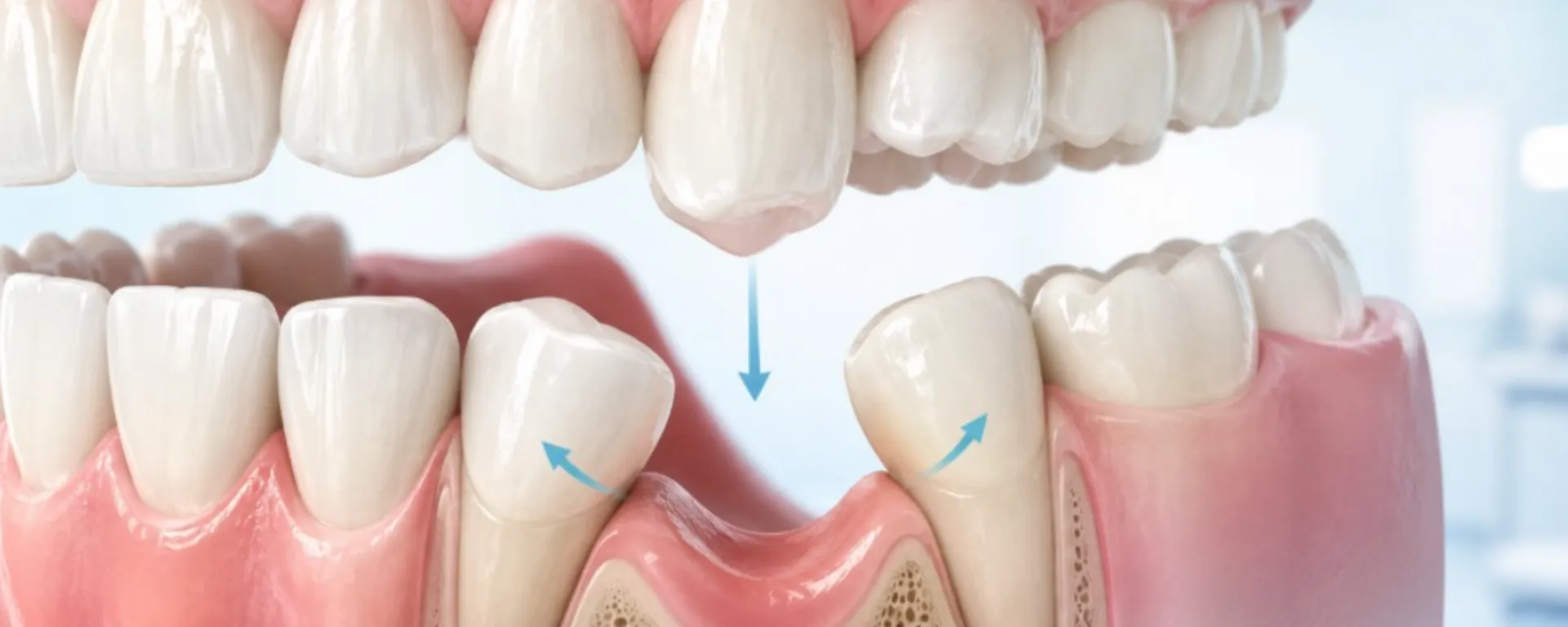
When a tooth is extracted, it does not simply leave a visible gap in the mouth; the contact relationships between the teeth, chewing balance, and the structure of the jawbone in that area may also change over time. Teeth are not completely fixed structures within the jaw and can undergo very small movements thanks to the periodontal tissues surrounding them. When the gap left by an extracted tooth remains untreated for a long time, neighboring teeth may begin to tilt or shift toward this space. The tooth in the opposing jaw may tend to extend toward the gap because the tooth it previously contacted is no longer present. These changes may disrupt the contact points between teeth, increase food impaction, and make it more difficult for chewing forces to be distributed evenly.

The speed and extent of changes caused by a missing tooth are not the same for everyone. Many factors influence this process, including the position of the missing tooth in the mouth, the person's age, the existing alignment of the teeth, the bite relationship, and the health of the gums and bone. In addition, after tooth extraction, the alveolar bone surrounding the root no longer receives the same level of functional stimulation, so a natural remodeling process begins in the area, and the width and height of the bone may decrease. Changes in bone volume may be particularly noticeable during the first few months after extraction. Therefore, leaving the gap created after tooth extraction without monitoring for a long time may make the planning of future implant, bridge, or other prosthetic treatments more complicated.
Does a Missing Tooth Cause Neighboring Teeth to Shift?
A missing tooth may cause the teeth immediately in front of and behind the gap to change position over time. Teeth normally remain in contact with their neighbors, and these contacts help maintain the balance of the dental arch. When a tooth is extracted, one of these contact points disappears. In particular, teeth adjacent to the gap may tilt, rotate, or move toward the empty space. This change does not occur at the same rate in every person and may remain limited in some individuals. However, with long-term tooth loss, the original width of the gap may change, and the axes of neighboring teeth may become misaligned.
The displacement of neighboring teeth does not create only an aesthetic problem. As teeth tilt, their natural contact points may change, causing food to become trapped more easily in these areas. The formation of new interdental spaces that are difficult to clean may increase plaque accumulation and consequently create conditions favorable for tooth decay or gum problems. In addition, tilted teeth may receive chewing forces at different angles than before. If the gap is to be restored with an implant or fixed prosthesis in the future, the remaining space must also be evaluated to determine whether it is sufficient. In some individuals, if the positions of the teeth have changed significantly, orthodontic repositioning may be necessary before prosthetic treatment.
Does a Missing Tooth Affect the Teeth in the Opposing Jaw?
The extraction of a tooth may also affect the tooth that contacts it in the opposing jaw. During normal chewing, the teeth in the upper and lower jaws meet at specific contact points. When a tooth is lost, the opposing tooth loses this contact support and may move toward the extraction gap over time. This change usually does not mean that the opposing tooth completely emerges from the jawbone; rather, it is seen as the tooth erupting further relative to the normal occlusal plane or changing its position. Although the extent of this process varies from person to person, it may become more pronounced in gaps that remain untreated for a long time.
Movement of the opposing tooth toward the gap may reduce the vertical space available for future treatment. For example, when a crown on an implant or another prosthesis is planned for the missing tooth area, excessive eruption of the tooth in the opposing jaw may leave insufficient space for the restoration. In addition, changes in bite contacts may cause some teeth to bear excessive loads or lead to premature contact points during chewing. Therefore, when evaluating a missing tooth, it is necessary to examine not only the extraction gap itself but also the position of the tooth in the opposing jaw and the overall bite relationship. An early evaluation may make it easier to manage potential space loss and bite changes that could develop later.
Does Bone Loss Occur Where a Tooth Has Been Extracted?
After tooth extraction, natural remodeling occurs in the alveolar bone at the extraction site. The tooth root forms a functional system together with the surrounding bone and contributes to the transmission of forces generated during chewing to the bone. When a tooth is extracted, this system changes, and the bone tissue undergoes remodeling as the extraction socket heals. This process does not consist solely of the socket filling with new bone; a reduction in the width and height of the alveolar ridge may also occur. Narrowing in the horizontal direction may be particularly noticeable, and a significant portion of these changes may take place within the first few months following extraction.
The amount of bone loss is not the same in every area or every person. The type of tooth extracted, the bone structure before extraction, a history of infection or periodontal disease in the area, whether the extraction was traumatic, and the person's healing characteristics may affect the outcome. A reduction in bone volume does not necessarily make future implant placement completely impossible, but the width and height of the available bone directly affect the treatment plan. When sufficient bone is not present, bone augmentation procedures may be required before implant placement or during the same procedure. Therefore, if an implant is being considered in the future, it may be beneficial to develop a plan to preserve the bone and soft tissues in the area starting from the extraction stage.
Can an Area Where a Tooth Has Been Missing for a Long Time Be Treated Later?
The fact that a tooth has been missing from an area for a long time does not mean that the area can no longer be treated. Teeth that have been missing for years can be replaced using different methods, such as implant-supported restorations, fixed bridges, or removable dentures in suitable cases. However, as time passes, neighboring teeth may have moved toward the gap, the opposing tooth may have overerupted, or the bone volume at the extraction site may have decreased, all of which can affect the treatment plan. Therefore, in cases of long-term tooth loss, rather than deciding directly on a single method, the alignment of the teeth, bite relationship, gum health, and amount of bone are evaluated together.
If an implant is planned for an area that has remained empty for a long time, the width and height of the bone and the positions of anatomical structures can be examined using imaging methods. When sufficient bone is available, implant treatment can be performed directly, whereas some areas with advanced bone loss may require bone augmentation procedures. If neighboring teeth have shifted significantly into the gap, orthodontic treatment may also be considered to create sufficient space for an implant or bridge. In cases where the opposing tooth has overerupted, additional procedures may be planned to correct the bite relationship. Therefore, delaying treatment for a long time does not eliminate the available options, but it may increase the number of procedures required and the overall scope of treatment.